AAHEP - Association for Animals, Horticultural & Equine Practitioners

AAHEP operates a customised accreditation programme for vocational qualifications that aim to develop professional practice and competency. When we accredit a course, we assign it an equivalent Level comparable to those listed on the Regulated Qualifications Framework (RQF) for England and Wales.

Organisational Membership of AAHEP is a pre-requisite for course accreditation.

Accreditation of a course by AAHEP is a robust process which can take some time to complete.

The AAHEP accreditation process recognises the entire qualification life cycle. From the initial commissioning and definition, through to its ongoing maintenance and review. A course accreditation from AAHEP demands an ongoing commitment from training providers to the entirety of this process. AAHEP will work with providers to ensure this ongoing commitment to the standards of quality and consistency that shape learner experience as part of any accreditation.
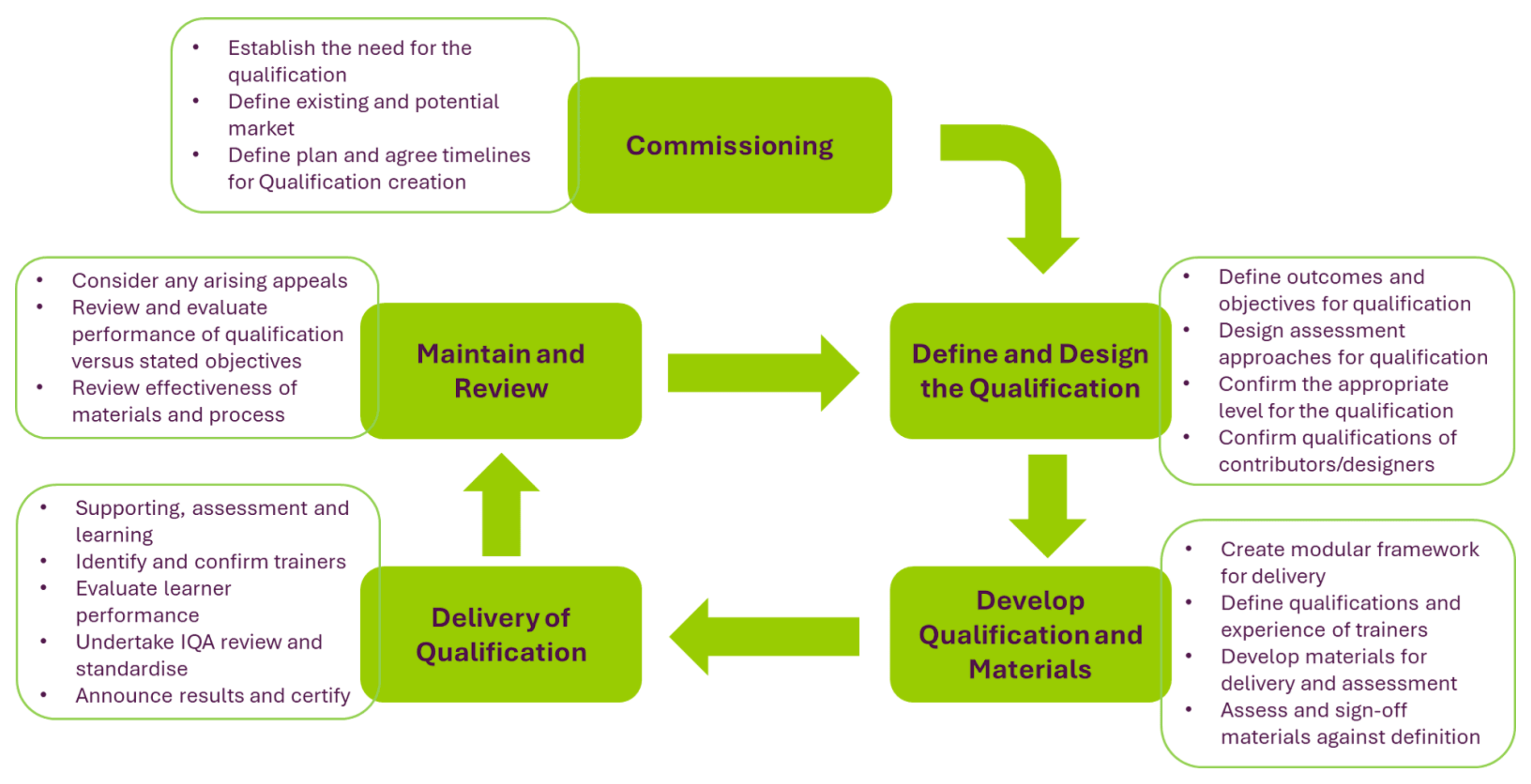
The Qualification Lifecycle

Objectives of the Accreditation Process

The accreditation process sets out to ensure that in the qualification/course there is:

  • a clear outline of the design development and management process(es) across the entire qualification lifecycle;
  • a clear and recognised requirement in the market for the course;
  • a clear set of outcomes and objectives that are understandable, deliverable and assessable for trainers, assessors and learners alike;
  • an appropriate design and structure in line with the requested academic level;
  • any entry requirements are simple to administer and appropriate to the qualification;
  • the qualification must be presented a coherent programme which follows a logical progression that clearly builds the learners’ theoretical knowledge, personal development and practical experience;
  • the learning outcomes are appropriate, in that they are making demands of the learner which are appropriate for the qualification’s defined objectives;
  • the learning outcomes are meaningful, in that they are clearly expressed and unambiguous;
  • the learning outcomes can be measured and assessed within the framework defined within the AAHEP Assessment Policy;
  • the overall qualification and supporting learning outcomes, including clear assessment frameworks must be available for the learners to follow;
  • all qualifications are designed in such a way as to reflect the protected characteristics of The Equality Act (2020) and align at all time to
  • the Athena Equal Opportunities and Diversity Policy;
  • the qualification can be delivered, maintained in an effective and standardized manner, and;
  • that there exists an appropriate framework for the review and evaluation of the qualification’s delivery and assessment

General Standards for Qualifications and Training Progammes

AAHEP employs core general standards of training which must be included in any accredited course. Courses must ensure that learners are provided with, and informed, as follows:

  • an appropriate (for Level) balance of face-to-face and self-learning and research;
  • respect for the client’s autonomy, cultural differences and rights throughout;
  • all training is provided within (and shall include clear instruction upon the need for) a Trauma-Informed framework;
  • learners are encouraged to maintain a practical awareness of the limits of their individual competence and always act in line therewith;
  • awareness of the importance of ongoing personal development and CPD;
  • maintain professional and ethical boundaries, and make decisions in alignment therewith, and;
  • ongoing use a mentor for advice, and/or professional/clinical supervision as appropriate.

Academic Requirements

The qualification design team and those delivering the training must be sufficiently qualified (to the Level being trained as a minimum) in the foundation topic(s) of the qualification. This guarantees that the defined learning objectives and supporting materials produced are appropriate for the qualification and to ensure that learners are correctly taught and directed through the learning process.

In certain cases, AAHEP will consider appropriate experience in support of the delivery condition for trainers.

There should be at least 2 tutors available to complete an accredited course to ensure contingency options around delivery should it be necessary.

The Process

Accreditation of a course by AAHEP is a robust process which can take some time to complete. This process will follow the structure laid out in the Qualification Lifecycle and Objectives (defined above).

  1. Applicants for course accreditation are welcome to contact us by email to arrange an initial discussion about your proposals.
  2. Applicants wishing to continue will need to become Organisational Members of AAHEP and will be invoiced accordingly.
  3. They will also be advised of all other fees related to the application and ongoing accreditation process.
  4. Applicants wishing to continue with the process will be provided with template materials to support the process.
  5. Applicants collate and prepare all required material and submit.
  6. On receipt of related materials and supporting qualification materials AAHEP will check for completeness.
  7. AAHEP will undertake a desk-based assessment of all materials will be undertaken in line with the relevant components of the Qualification Lifecycle and Objectives (above)
  8. Any concerns or points for clarification we will be returned to the applicant; the process is halted until these have been resolved or rectified.
  9. Only when AAHEP is satisfied that the submission fully satisfies all defined conditions across the qualification life cycle will accreditation be awarded
  10. AAHEP will advise applicants of the final decision by email within 2 working days.

In some circumstances it may be appropriate to undertake a site visit. In such cases the costs of this will be passed on to the applicant.

Continued Professional Development (“CPD”)

CPD can cover a significant range of options and topics, as such the validation process is less rigid than that for accredited courses.
In setting its minimum standards for CPD courses AAHEP is establishing a foundation quality level for such courses/events, however it in recognising the potential diversity it maintains a flexible process and approach.

CPD validations are issued in hours. For example, a half day CPD is likely to be validated to provide around 3.5 hours.
AAHEP will assess both quality and quantity. It the course of sufficient value to warrant validation and is there sufficient content to justify the hours requested.

The application process requires an outline of the CPD’s core topic, its overall objective, and the prospective learner outcomes.
AAHEP also expects that those leading the CPD can prove appropriate qualifications, or levels of experience.

AAHEP acknowledges that CPD is alternatively referred to in North America Continuing Education (CE") or Continuing Educational Unit. AAHEP accordingly accredits courses and/or events for CE. To facilitate this 1 CE unit is recognised to be the equivilent to 10 hours of learning and or attendance.